

The ROI of Web Accessibility: Why Inclusive Web Design is a Revenue Driver
Most business owners treat web accessibility like a digital tax. They view it as a frustrating legal checklist, an IT headache, or a defensive measure to avoid a sudden lawsuit.
If that is how your company looks at inclusive web design, you are actively leaving money on the table.
When you build a website that ignores a massive segment of the population, you are not just risking a legal demand letter. You are artificially shrinking your total addressable market, driving up your customer acquisition costs, and handing high-intent buyers directly to your competitors.
In 2026, the ROI of web accessibility is no longer a theoretical debate. Building a digital experience that everyone can use is a proven, measurable revenue driver. It improves your search engine rankings, reduces cart abandonment, and ensures your brand captures every possible sale.
Here is the data-driven business case for inclusive web design, and why making your website accessible is one of the fastest ways to drive real growth.
The Hidden Market You Are Currently Blocking
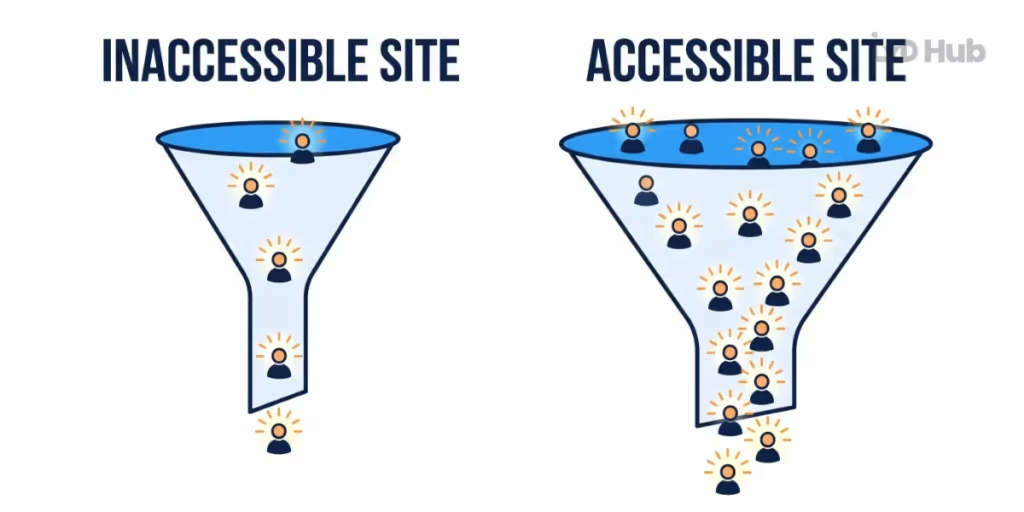
When business owners picture web accessibility, they often imagine a very narrow use case. The reality is that the disability demographic is vast, diverse, and possesses massive purchasing power.
According to global estimates, people with disabilities control roughly $8 trillion in disposable income [needs verification]. This group includes individuals with visual impairments, hearing loss, motor control limitations, and cognitive challenges. It also includes people with temporary disabilities, like a broken arm, or situational limitations, like trying to read a screen in bright sunlight.
When these buyers encounter a website that is difficult to navigate, they do not stick around to figure it out. In fact, up to 70% of disabled shoppers will immediately abandon a website that poses a digital barrier, taking their purchasing power directly to a competitor [needs verification].
Retailers lose billions of dollars annually to this “click-away” effect. If your checkout button cannot be activated by a keyboard, or if your product descriptions cannot be read aloud by assistive software, that customer is gone.
For e-commerce brands, an inaccessible checkout is one of the most expensive structural errors you can make—if you are auditing your store, this accessibility gap is a critical addition to our Shopify Success Blueprint: 9 UX Mistakes. Furthermore, disabled consumers heavily influence the purchasing decisions of their families, friends, and households. Alienating one user often means losing the entire household’s business.
By implementing inclusive design, you immediately remove the friction that is artificially suppressing your sales. You expand your market reach overnight, turning abandoned carts into clicks that convert.
What Does Inclusive Web Design Actually Look Like?
Before diving into the financial returns, it helps to understand what we actually mean by accessibility. It is not about making your website look boring or removing your brand identity. It is about building a structurally sound digital foundation.
Accessibility standards are governed by WCAG (the Web Content Accessibility Guidelines). Think of WCAG as the universal rulebook for making websites usable for everyone. It outlines exactly how digital content should be coded and designed so that no one is locked out.
To meet these standards, your website must accommodate tools like a screen reader—a piece of software that reads the contents of a web page aloud for visually impaired users.
For a screen reader to work, your developers use ARIA tags (Accessible Rich Internet Applications). ARIA is simply a set of invisible code tags that tell assistive software exactly what a button, a form, or a navigation menu does. If a visual button looks like a shopping cart, ARIA tells the blind user’s software, “This button adds the item to your cart.”
Beyond code, accessibility impacts visual design. Your site must maintain a proper contrast ratio, which is the mathematical difference in brightness between your text and its background. If your text does not stand out enough from the background, users with low vision or color blindness cannot read your message. To understand how aesthetic choices impact both brand perception and usability, read our guide on Beyond Aesthetics: Decoding the Language of Colors in Design.
The SEO and AI Advantage: How Accessibility Drives Traffic
The strongest argument for the ROI of web accessibility is its direct impact on organic search traffic.
Many founders do not realize that Google’s search crawlers are essentially blind users. A search engine bot cannot “see” your beautiful hero image or watch your promotional video. It relies entirely on your website’s underlying code to understand what your business does.
When you optimize your website for a screen reader, you are simultaneously optimizing it for search engines.
If you use clear, descriptive headings (H1, H2, H3) so a visually impaired user can skip to the relevant section, you are also handing Google a perfect map of your content. If you write descriptive “alt text” (hidden descriptions) for your images, you give search engines more context to rank your pages.
This structural clarity is even more critical for UX accessibility in 2026. Modern AI answer engines (like ChatGPT or Google AI Overviews) do not just index links; they extract specific answers to feed directly to users. These AI models rely on the exact same semantic HTML and structured data that screen readers use.
If your website is an inaccessible, unstructured mess, AI models cannot parse your product features or pricing. To see how modern search relies on these technical layers, explore our deep dive on SEO, GEO, AIO, AEO & SXO. By investing in accessibility, you guarantee that both human buyers and machine algorithms can consume and recommend your brand.
Diagnosing the Friction: Why Users Are Leaving
How do you know if a lack of accessibility is hurting your bottom line right now? You have to look at user behavior.
High bounce rates, abandoned forms, and short session durations are not just random statistical anomalies. They are symptoms of a frustrating user experience. When users click elements that do not respond, or struggle to read low-contrast text on mobile devices, they experience cognitive overload.
This frustration often manifests as “rage clicks”—when a user repeatedly clicks an element in frustration because it is not working correctly for their specific device or navigation method. Tracking these behaviors is critical to diagnosing revenue leaks. You can learn more about identifying these specific user hurdles in our breakdown of Website Heatmaps.
Every time a user abandons a broken digital experience, your cost per acquisition (CPA) goes up. You paid Google or Facebook to get them to your site, but your website’s structural flaws threw that money away. These invisible roadblocks are just some of the 6 Pain Points That Show Your Website Is Hurting Your Business.
The “Overlay” Trap: Why Cheap Plugins Hurt Your Business
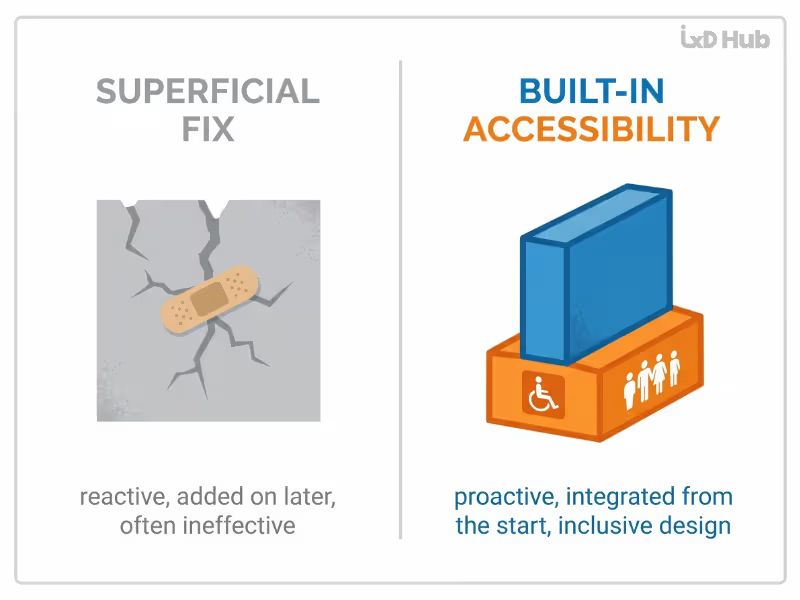
As awareness of an ADA compliance website has grown, a massive industry of cheap, automated “accessibility overlays” has emerged. These are the small widgets you see in the corner of websites that offer to change font sizes or adjust colors for a small monthly fee.
For a busy small business owner, these $49-a-month plugins seem like a perfect, inexpensive fix.
In reality, they are a massive business risk. Automated overlays cannot fix structural coding problems. They cannot add missing ARIA tags to a complex checkout form, and they cannot rewrite confusing navigation paths. Worse, data shows that these overlays frequently conflict with the native screen readers that disabled users already have installed on their computers, making your website harder to use.
From a legal standpoint, relying on a cheap overlay does not protect you from lawsuits. In fact, plaintiffs often specifically target websites using these widgets because it signals that the underlying code is broken.
To achieve a true ROI, accessibility cannot be a band-aid slapped on after the fact. It must be woven into the fabric of your digital presence.
Legal Risk as a Secondary Cost
While market expansion and SEO dominance should be your primary motivators, we cannot ignore the financial reality of digital compliance.
In many countries, including the United States, websites are legally considered places of public accommodation. If your website is not accessible, you are vulnerable to civil lawsuits.
Defending an accessibility lawsuit can cost a small business tens of thousands of dollars in legal fees, settlement payouts, and emergency developer costs to fix the site under a court-ordered deadline.
This is unplanned, non-negotiable downtime that distracts you from running your business. By proactively budgeting for an accessible website build or redesign, you neutralize this unpredictable legal threat. You stop playing defense and start playing offense, securing your digital assets while your competitors leave themselves exposed.
Interactive Element: Calculate Your Lost Revenue
Not sure how much revenue you might be losing to inaccessible design? Plug your monthly traffic and average order metrics into this calculator to model the financial impact of the “click-away” effect.
Building Accessibility into Your Growth Strategy
If your website is structurally outdated, trying to patch it piece by piece is often more expensive than starting fresh. True inclusive design is built from the ground up, ensuring that every color choice, navigation menu, and checkout flow serves the widest possible audience.
If you are considering a major digital overhaul to fix these issues, it is critical to plan carefully. You can use Your Checklist For Website Redesign 2025 to ensure that accessibility is mapped out in sprint zero, rather than treated as a post-launch afterthought.
When you prioritize usability from day one, you ensure that every core function on your site actually works for the people trying to pay you.
Turn Your Website into an Inclusive Revenue Engine
The ROI of web accessibility is clear: you acquire more customers, you keep them on your site longer, you rank higher in modern search engines, and you eliminate the threat of expensive legal action.
Inclusive design is not a charity initiative; it is a competitive advantage. It is time to Move Beyond Buzz and recognize that a usable website is a profitable website. When you commit to a standard where every user can interact with your brand effortlessly, you are setting the stage to Learn, Build & Scale your business aggressively.
At IxD Hub, we engineer digital experiences that look stunning, perform flawlessly, and welcome every possible buyer. We build custom websites and marketing strategies focused on one metric: real growth.
To learn more about how we blend UX optimization, technical SEO, and modern architecture into high-performing digital platforms, visit our Full Service Digital Agency page.
Not sure if your site is accessible? Get a quick expert read.
👉 Message us directly on WhatsApp to chat with our UX team about your current website’s structural health.
Prefer to outline your project in detail? Fill out our Contact Page form, and we will help you map out a digital strategy that leaves no customer behind.