

The B2B CRO Audit Blueprint: Turning High-Traffic Sites into Conversion Engines
For many B2B organizations, digital marketing efforts are heavily skewed toward a single objective: acquiring more traffic. Marketing teams invest aggressively in Search Engine Optimization (SEO), pay-per-click (PPC) campaigns, and content marketing to drive thousands of visitors to their domain every month.
Yet, a common and frustrating narrative emerges in the boardroom: website traffic is up 40% year-over-year, but the number of qualified sales enquiries remains entirely flat.
Generating traffic is only half the equation. If your website resembles a leaky bucket, pouring more money into advertising simply results in more expensive water on the floor. Your website must do more than attract visitors; it must guide the right visitors seamlessly toward meaningful business actions.
This is where a structured B2B CRO audit (Conversion Rate Optimization audit) bridges the gap between marketing spend and sales pipeline. In this guide, we will explore why high-traffic sites fail to convert, identify common B2B user experience barriers, provide an interactive calculator to model your revenue opportunity, and deliver a comprehensive audit blueprint to turn your website into a measurable conversion engine.
What Is B2B Conversion Rate Optimization (CRO)?
Conversion Rate Optimization (CRO) is the systematic, data-driven process of increasing the percentage of website visitors who take a desired action.
In B2C e-commerce, a conversion is usually a direct, immediate credit card purchase. In the B2B sector, the buying cycle is much longer, and the buying committee is more complex. Therefore, a B2B conversion is typically a lead generation event—such as filling out a contact form, requesting a software demo, downloading a technical whitepaper, or booking a consultation.
At its core, CRO is not about manipulating users with aggressive pop-ups or changing button colors based on a designer’s gut feeling. It is the scientific process of understanding how users navigate your site, identifying what stops them from taking action (conversion friction), and systematically improving the user experience (UX) to remove those barriers.
The Core Dilemma: Why High Traffic Does Not Equal Qualified Leads
It is entirely possible to double your website traffic and simultaneously decrease your qualified leads. To understand why, business leaders must distinguish between four distinct stages of the digital commercial journey:
- Traffic: The raw volume of people arriving at your site.
- Conversions: The number of visitors who complete a form or take a tracked action.
- Qualified Leads: The subset of conversions that actually match your Ideal Customer Profile (ICP) and possess genuine buying intent.
- Customers: The qualified leads that your sales team ultimately closes.
When a B2B website suffers from low conversions despite high traffic, the root cause usually falls into one of two categories:
1. Intent Mismatch: Your marketing is attracting the wrong audience. For example, a highly ranked blog post might draw thousands of university students researching a topic, rather than the enterprise CTOs looking to buy your software.
2. Conversion Friction: The right buyers are arriving, but the website’s design, messaging, or technical performance makes it too difficult, confusing, or untrustworthy for them to proceed. This is why designing for lead generation requires more than just an attractive layout; it requires strategic, conversion-focused architecture.
Diagnosing the Friction: Common B2B Conversion Barriers
A comprehensive B2B CRO audit looks for specific roadblocks that interrupt the user journey. Here are the most frequent conversion killers hiding in enterprise websites.
1. Unclear Messaging and Weak Value Propositions
Your “Value Proposition” is the promise of value to be delivered. When an executive lands on your homepage, they need to know three things within five seconds: What do you do? Who do you do it for? Why are you better than the alternative?
If your headline reads like vague corporate jargon (“Synergistic Paradigm Solutions for the Modern Enterprise”), visitors will bounce. Clarity always beats cleverness. Furthermore, the message on your landing page must align perfectly with the ad or search query that brought the user there—a concept known as message match.
2. Misaligned or Hidden Calls to Action (CTAs)
A Call to Action (CTA) is the button or link guiding the user to the next step. A common mistake on B2B websites is offering too many competing CTAs on a single page, resulting in “choice paralysis.”
Alternatively, the CTA might demand a massive leap in commitment. Asking a first-time visitor to “Buy Now” for a $50,000 enterprise software solution is unrealistic. Effective landing page optimization aligns the CTA with the user’s funnel stage—offering an ungated technical guide for early-stage researchers, and a “Request a Custom Demo” button for high-intent buyers.
3. Form Fatigue and Excessive Data Collection
Every additional field on a contact form is a barrier to entry. B2B companies often ask for First Name, Last Name, Work Email, Phone Number, Company Size, Revenue, and Job Title just to download a simple PDF checklist.
Ask your sales team: Do we actually need their phone number at this exact moment? If sales will not call them today, remove the field. Reducing a form from seven fields to three fields is consistently one of the fastest ways to improve B2B conversion rates.

Understanding User Behavior: Analytics, Heatmaps, and Session Recordings
You cannot fix what you cannot measure. A professional CRO strategy replaces internal opinions with concrete behavioral data.
- Website Analytics (e.g., Google Analytics 4): Analytics tell you what is happening. They reveal which pages have the highest bounce rates, where users drop off in the navigation flow, and which traffic channels yield the highest conversion rates.
- Heatmaps: Heatmaps tell you where it is happening. They are visual color overlays that track where users click, how far down the page they scroll, and where they move their mouse. Using heatmaps can reveal critical website blind spots, such as users trying to click on graphics that aren’t actually links, or abandoning a page right before the CTA appears.
- Session Recordings: Session recordings tell you why it might be happening. These tools record anonymized videos of real user browsing sessions. Watching a user repeatedly fail to fill out a broken mobile form provides instant, undeniable evidence of conversion friction.
(Note: Responsible CRO practices always ensure that analytics and recording tools anonymize Personally Identifiable Information to comply with privacy regulations).
The Financial Impact of Incremental Conversion Improvements
When discussing conversion optimization with stakeholders, it is crucial to understand the mathematical difference between an absolute percentage point and a relative percentage.
If your website currently converts at 2.0%, and optimization efforts raise it to 3.0%:
- That is an increase of 1 percentage point (3 minus 2).
- However, that represents a 50% relative increase in your total volume of leads (1 is 50% of 2).
Because the fixed costs of hosting your website and creating content remain largely the same, that 50% relative increase in qualified leads flows powerfully into your sales pipeline without requiring a 50% increase in your advertising budget. This shift from vanity traffic metrics to actual revenue outcomes is central to effective B2B SaaS pipeline generation.
To see exactly what this math means for your bottom line, use the interactive calculator below.
B2B Conversion Opportunity Calculator
Adjust the sliders to estimate the financial impact of improving your website conversion rate.
*Illustrative estimate only. Assumes consistent traffic quality. Does not guarantee actual revenue.
Save your business case
Send this estimate to your inbox to share with your team.
By submitting, you consent to receive insights from IxD Hub. You can unsubscribe anytime.
A/B Testing: Making Data-Driven Decisions (Not Guesses)
Once an audit identifies a problem and behavioral data confirms it, CRO specialists formulate a hypothesis. For example: “Removing the mandatory phone number field on the demo form will increase form submissions.”
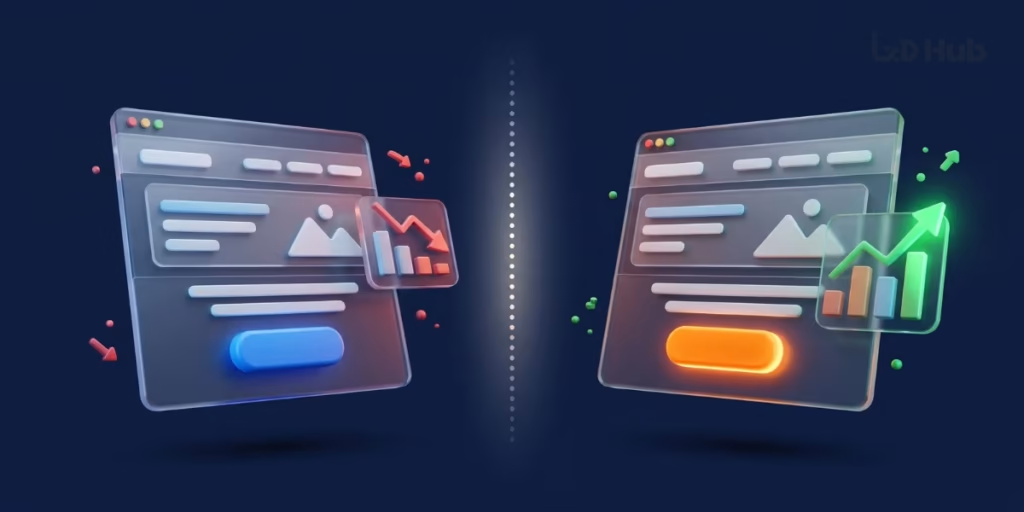
This hypothesis is proven through A/B Testing (or split testing). Half of your website traffic is shown the original page (Control – Version A), and the other half is shown the redesigned page (Variant – Version B). Analytics software tracks which version produces more conversions.
The Importance of Statistical Significance
A critical mistake in DIY conversion optimization is ending a test too early. If Version B gets 5 conversions on Monday and Version A gets 2, an eager marketer might declare Version B the winner and change the website permanently.
In data science, this is known as a False Positive. It is the equivalent of flipping a coin three times, getting heads all three times, and concluding the coin only has heads. To ensure the result isn’t just random luck, tests must run until they achieve statistical significance (usually a 95% confidence level).
Because B2B websites generally have lower traffic volumes than B2C e-commerce sites, reaching statistical validity can take weeks. Professional CRO teams calculate the required sample size before a test begins to prevent businesses from making permanent, damaging changes based on flawed data.
Technical Performance, Mobile UX, and Trust Signals
Even the most persuasive copywriting will fail if the technical foundation of the website is compromised.
- Website Speed and Core Web Vitals: B2B buyers are impatient. A page that takes five seconds to load experiences exponentially higher bounce rates than a page loading in under two seconds. If your code is bloated or your servers are slow, visitors will leave before your value proposition even renders.
- Mobile UX: While complex B2B purchases are often finalized on desktop computers in the office, the initial research phase increasingly happens on mobile devices during commutes or off-hours. If your site relies on pinch-to-zoom navigation, or features forms that break on smaller screens, you are actively driving mobile traffic to your competitors.
- Trust Signals: In the B2B space, risk mitigation is everything. Buyers need to know you are a credible, safe choice. Strategic placement of trust signals—such as recognized client logos, quantifiable case study metrics, industry certifications, and real human testimonials—lowers the perceived risk and dramatically improves form completion rates.
The Practical B2B CRO Audit Blueprint

To start turning your high-traffic site into a conversion engine, use this structured audit framework to evaluate your digital presence objectively.
| Audit Category | What to Inspect | Warning Signs (Red Flags) | Recommended Improvement | Priority |
| Value Proposition | Above-the-fold messaging (hero section). | Headline uses vague jargon. Visitor cannot tell what you sell within 5 seconds. | Rewrite headline to clearly state what you do, who it’s for, and the core benefit. | HIGH |
| User Journey | Main navigation and internal linking. | Too many dropdown menus; dead-end pages; no logical flow to the contact page. | Simplify primary navigation. Ensure every page has a logical “next step.” | HIGH |
| CTAs (Calls to Action) | Visibility, placement, and commitment level. | “Submit” is used as button text. Multiple competing buttons of the same color on one page. | Use action-oriented text (“Get Your Demo”). Use high-contrast colors for primary CTAs. | HIGH |
| Form Usability | Contact and lead generation forms. | Forms require more than 5 fields. Asking for budget or phone number too early. | Remove non-essential fields. Use multi-step forms for complex B2B inquiries. | HIGH |
| Trust Signals | Social proof, case studies, and security. | Missing client logos. Testimonials lack real names or photos. No privacy reassurances near forms. | Place recognized client logos near the hero section. Add 1-2 sentence testimonials near lead forms. | MEDIUM |
| Mobile UX | Responsive design and touch targets. | Buttons are too small to tap. Forms require excessive scrolling. Text requires pinch-to-zoom. | Increase font sizes for mobile. Make CTAs full-width sticky buttons on mobile screens. | HIGH |
| Analytics & Heatmaps | Goal tracking and behavioral data. | GA4 conversion events are not set up. No heatmap software installed. | Install heatmaps to see where users actually click and scroll. Verify GA4 event tracking. | MEDIUM |
| Page Performance | Load times and Core Web Vitals. | Page takes > 4 seconds to load visually. Large uncompressed images. | Compress media. Minimize heavy scripts. Consider high-availability caching. | HIGH |
When to Consider Professional CRO and Website Redesign Support
Conducting a basic heuristic evaluation internally using the blueprint above is a great starting point. However, true Conversion Rate Optimization is a multidisciplinary effort requiring expertise in UI/UX design, technical web development, data science, and behavioral psychology.
If your organization lacks the specialized tools to run statistically valid A/B tests, or if your current Content Management System (CMS) is so rigid that executing a landing page redesign or custom platform integration requires months of internal IT approval, it is time to seek external expertise.
A professional technology partner does not guess what might look better. They deploy advanced analytics, diagnose deep-rooted technical friction, and engineer custom solutions designed specifically to capture and route high-quality leads.
Turn Existing Traffic into Better Business Opportunities
Your website is your most valuable, 24/7 sales asset. By systematically removing user friction, clarifying your value proposition, and testing data-driven improvements, you can stop leaving money on the table and start maximizing the return on the traffic you already have.
Getting traffic but not enough qualified enquiries? Let’s identify what is stopping your visitors from taking the next step. At IxD Hub, we specialize in data-driven UI/UX design, technical performance, and conversion-focused web development.
Contact the IxD Hub team today to discuss your website optimization requirements, or chat with our digital experts directly on WhatsApp to start turning your traffic into measurable business growth.
Frequently Asked Questions (FAQs)
Why is my B2B website traffic high but my conversions are low?
High traffic with low conversions typically points to one of two issues: an intent mismatch (your marketing or SEO is attracting the wrong audience for your product), or conversion friction (the right audience is arriving, but confusing navigation, slow page speeds, or overly complex forms are preventing them from contacting you).
What is included in a B2B CRO audit?
A comprehensive B2B CRO audit evaluates multiple layers of a website. It includes a heuristic UI/UX review, analysis of user journey and navigation flows, technical performance testing (page speed and mobile responsiveness), evaluation of messaging and CTA placement, and the review of behavioral data via heatmaps and session recordings.
How do you calculate a website conversion rate increase?
Conversion increases are measured in two ways. An absolute percentage point increase is the literal difference between the old and new rate (e.g., moving from 2.0% to 3.0% is a 1 percentage point increase). A relative percentage increase measures the growth volume (e.g., moving from 2.0% to 3.0% means you are generating 50% more leads than before).
How long should a B2B A/B test run for statistical significance?
The duration depends heavily on your website traffic volume, the baseline conversion rate, and the expected impact of the change. Because B2B environments have lower traffic than B2C retail sites, tests often need to run for 2 to 4 weeks (accounting for full business cycles and weekends) to achieve a 95% statistical confidence level and avoid misleading “false positive” results.